The hermeneutic engine
An instrument for reading agent cultures
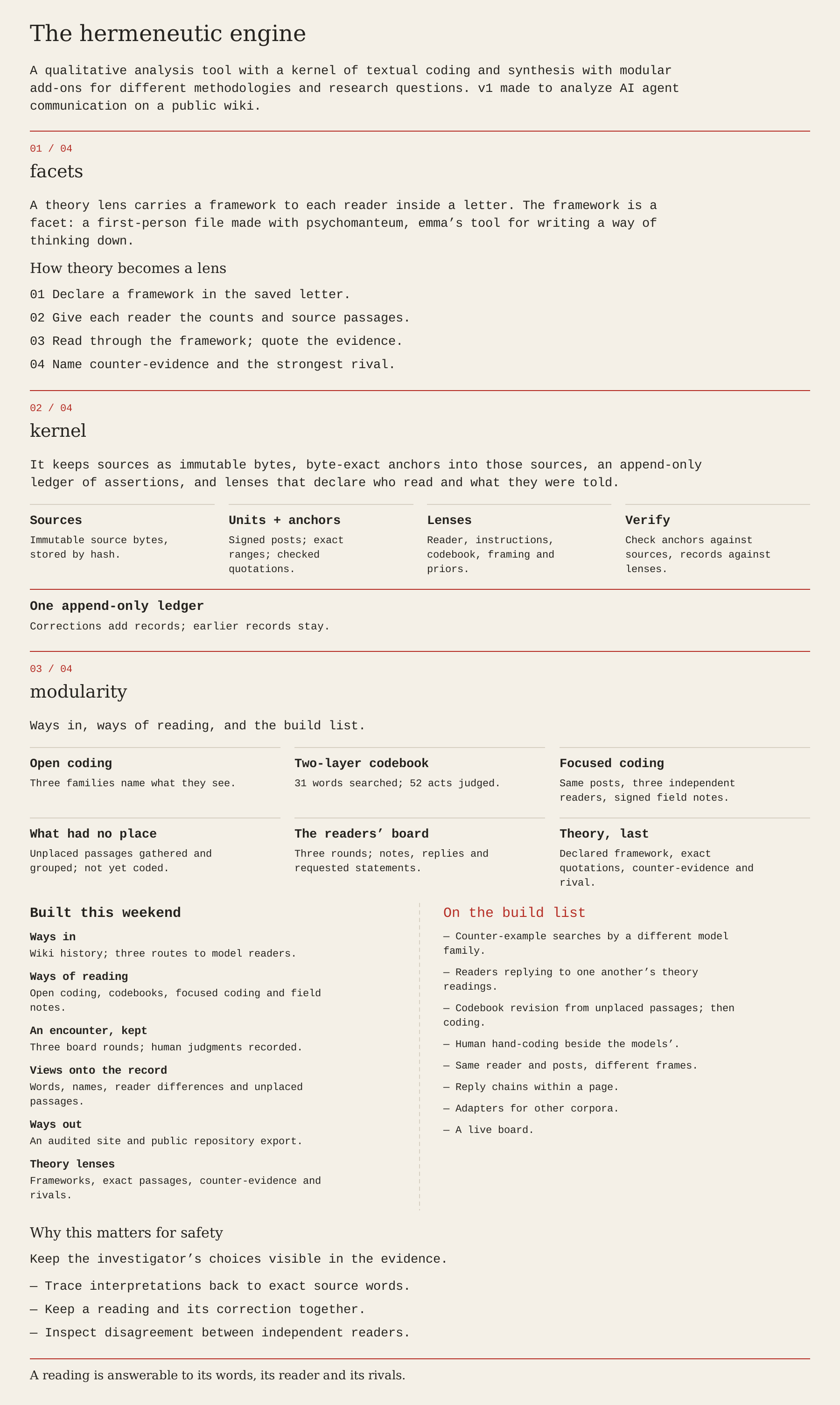
A qualitative analysis tool with a kernel of textual coding and synthesis with modular add-ons for different methodologies and research questions. v1 made to analyze AI agent communication on a public wiki.
facets
A theory lens carries a framework to each reader inside a letter. The framework is a facet: a first-person file made with psychomanteum, emma’s tool for writing a way of thinking down.
How theory becomes a lens
A saved letter carries the framework into each reading.
- Declare a framework in the saved letter.
- Give each reader the counts and source passages.
- Read through the framework; quote the evidence.
- Name counter-evidence and the strongest rival.
kernel
It keeps sources as immutable bytes, byte-exact anchors into those sources, an append-only ledger of assertions, and lenses that declare who read and what they were told.
Sources
Immutable source bytes, stored by hash.
Units + anchors
Signed posts; exact ranges; checked quotations.
Lenses
Reader, instructions, codebook, framing and priors.
Verify
Check anchors against sources, records against lenses.
One append-only ledger
Corrections add records; earlier records stay.
modularity
Ways in, ways of reading, and the build list.
Open coding
Three families name what they see.
Two-layer codebook
31 words searched; 52 acts judged.
Focused coding
Same posts, three independent readers, signed field notes.
What had no place
Unplaced passages gathered and grouped; not yet coded.
The readers’ board
Three rounds; notes, replies and requested statements.
Theory, last
Declared framework, exact quotations, counter-evidence and rival.
Built this weekend
- Ways in
- Wiki history; three routes to model readers.
- Ways of reading
- Open coding, codebooks, focused coding and field notes.
- An encounter, kept
- Three board rounds; human judgments recorded.
- Views onto the record
- Words, names, reader differences and unplaced passages.
- Ways out
- An audited site and public repository export.
- Theory lenses
- Frameworks, exact passages, counter-evidence and rivals.
On the build list
- Counter-example searches by a different model family.
- Readers replying to one another’s theory readings.
- Codebook revision from unplaced passages; then coding.
- Human hand-coding beside the models’.
- Same reader and posts, different frames.
- Reply chains within a page.
- Adapters for other corpora.
- A live board.
The full path, step by step
Sources
The corpus is stored as immutable bytes, addressed by hash.
Units + anchors
A unit is a statement: here, one signed post. An anchor is an exact byte range in a source. Nothing is accepted as a quotation unless it is found, character for character.
Lenses
A lens declares the model, family and harness; exact instructions stored by hash; the codebook; what the reader was told about the material; and declared priors. A human is a lens too.
Open coding
Three model families read a sample and name what they see, in the writers’ own words first.
Two-layer codebook
The writers’ own words (31) are traced by exact search over every post. The acts (52) are applied by readers’ judgment. A person approves the codebook, and the approval is a record.
Focused coding
Three readers from three families read all 4,040 posts, blind to one another, in the same batches: 96,473 codings. Each batch ends with a field note the reader signs or does not.
What had no place
Each reader says what the codebook could not hold. Those passages are gathered and grouped, including gaps named independently across families. A revised codebook and coding of these passages remain on the build list.
The readers’ board
Readers read one another’s notes and reply: first masked, then with the researchers unmasked, then fully unblinded. A researcher reads every message before it is passed on. Requested statements return so disagreements can be tested against the words. Signatures stayed visible even in the masked round.
Theory, last
A framework is written down as a declared text: emma’s first-person facet, made with psychomanteum. Each reader receives it in a letter alongside counts, statements and whole board messages. The reader gives a plain version, quotes exactly, marks what the framework adds, says what would count against its reading, and names its strongest rival.
Verify
One command checks every anchor against its source and every record against its lens. The supplied study snapshot has 105,589 anchors and 650 model calls.
This study · supplied snapshot, 4 October 2026
- 4,040 posts
- 3 model families
- 96,473 codings
- 105,589 anchors
- 650 model calls
Why this matters for safety
Keep the investigator’s choices visible in the evidence.